Introduction
There are several types (formats) for crossword puzzles.
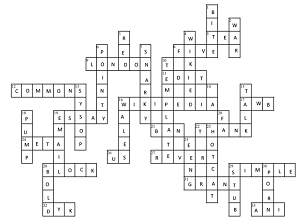
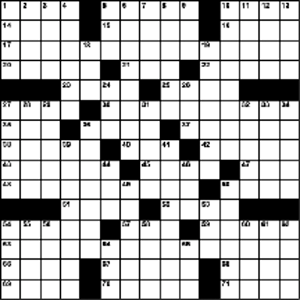
Below shows what I will call "type A" and "Type B".
Type A
Image From: commons.wikimedia.org
Type B
Image From: commons.wikimedia.org
Project #1a
Create a "Type B" crossword puzzle using the pseudo code below.
(Be sure to click on the link and read the information there
first. This will help define the problem.)
Here is a list of words you can use for testing.
(It is the first line of Shakespeare's play Richard III.)
You should also develop your own test lists.
words = [ 'Now', 'is', 'the', 'winter', 'of', 'our', 'discontent',
'Made', 'glorious', 'summer', 'by', 'this', ',sun', 'of', 'York' ]
Note: Treat uppercase and lowercase letters the same.
Algorithm
Pseudo code from:
Generating a Crossword Puzzle
algorithm IterativePlacement(words, maxWords):
// INPUT
// words = list of words to place on the crossword
// maxWords = the maximum number of words to place
// OUTPUT
// crossword = the generated crossword grid
shuffle(words)
word <- pop(words)
crossword <- place(word, null, 0, 0, HORIZONTAL)
count <- 1
while count < maxWords and len(words) > 0:
word <- pop(words)
for letter in word:
for y in rows(crossword):
for x in cols(crossword):
if crossword[y, x] = letter:
placement, ok <- canPlace(word, crossword, x, y)
if ok:
crossword <- place(word, crossword, placement.x,
placement.y, placement.direction)
count <- count + 1
continue
return crossword
Design Questions/Thoughts:
- Coordinate 0,0 is the center of the grid/matrix, Not the upper-left corner?
- Is it best to use an odd number of columns and rows?
(This fits nicely with the idea that 0,0 coordinates being in the center.)
Project #1b
After creating a crossword, display it as a "Type B" (shown above).
Links
Algorithm to generate a crossword
algorithms/docs/crossword-puzzle.md
Generating a Crossword Puzzle
How we developed a scalable, incredibly fast crossword generator