Introduction
In RISC-V assembly language, compound data collections like arrays and linked lists do not exist as built-in high-level abstractions. Instead, they are managed purely through memory addresses, pointers, and manual byte-offset calculations.
The primary difference comes down to memory layout. Arrays use contiguous chunks of memory, while lists utilize dynamically linked pointer nodes scattered across the heap.
Array
In RISC-V assembly, an array is a contiguous block of memory. Because a standard integer (.word) is 4 bytes, you must navigate the array by shifting your memory addresses in multiples of 4.
Here is a complete, runnable example that iterates through an array of 5 integers, sums them up, and stores the final result in memory.
Linked List
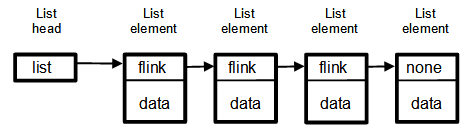
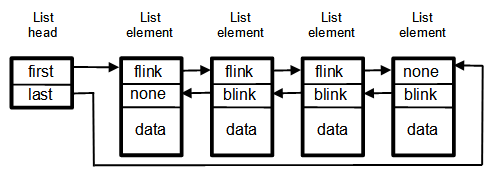
Note: flink is "forward link"; blink is "backward link".
linked-list (GitHub)