
I am currently using windows 10, but plan to switch to Linux at some point.
"It has come to the Triarii"
Introduction
The RISC-V instruction set is modular. It has a small mandatory base integer specification and optional standard extensions. There is no single monolithic "complete" list for all use cases. Chips mix a base (like RV32I or RV64I) with extensions for multiplication, atomics, and floating-point.
The core 32-bit or 64-bit base integer instruction set (RV32I/RV64I) containing basic math, loads, stores, and control flow.
Personal Note
People new to programming should be exposed to assembly language programming to get a feel of how computers work.
I created/collected this hodgepodge of material to teach myself something about RISC-V assembly language programming. It could be used as the start of an assembly language programming course after it is cleaned up and reorganized.
Note: Over the years I have programmed a little in 6 or 7 different assembly languages.
Links
RISC-V (Wikipedia)
RISC-V assembly language (Wikipedia)
RISC-V instruction listings (Wikipedia)
You Can Learn RISC-V Assembly in 10 Minutes | Getting Started RISC-V Assembly on Linux Tutorial (YouTube)
RISC-V Assembly Code #1: Course Intro, Registers
(YouTube)
RISC-V Assembly Code #2: ALU, Load, Store Instructions
(YouTube)
RISC-V Assembly Code #3: Branch, Jump, Call, Return, etc
(YouTube)
RISC-V Assembly Code #4: Asm Directives, Pseudo Instructions
(YouTube)
RISC-V Assembly Code #5: RV32 v RV64
(YouTube)
RISC-V Assembly Code #6: Multiply, Divide Instructions
(YouTube)
RISC-V Assembly Code #7: Example Program
(YouTube)
RISC-V Assembly Code #8: Floating Point-IEEE 754
(YouTube)
RISC-V Assembly Code #9: Floating Point Instructions (pt. 1)
(YouTube)
RISC-V Assembly Code #10: Floating Point Instructions (pt. 2)
(YouTube))
Beginners RISC-V Assembly (YouTube)
This example uses the standard C library write command. It is
more complicated than the RARS simulator. I suggest you come
back to this later when you know more RISC-V assembly Language.
RISC-V Assembly Hello World (Part 1)
(YouTube)
RISC-V Assembly Hello World (Part 2)
(YouTube)
QEMU - A generic open source machine emulator and virtualizer (I use RARS. See below.)
Resources
RISC-V Assembly Language Reference Card
RISC-V Syscalls
(RISC-V assembly system calls are executed
using the ecall instruction (system call). By standard convention,
the system call number must be loaded into register a7, and any
required arguments are passed through registers a0 to a6.)
RISC-V Assembly Programmer’s Manual
RISC-V Assembly Programming
(The website contains a set of resources to support learning/teaching
assembly programming using the RISC-V ISA.)
(Instruction Set Architecture (ISA))
RARS (RISC-V Assembler and Runtime Simulator)
This is the assembler/simulator I am using to learn RISC-V assembly language programming. It is written in Java and should run everywhere Java runs. (Windows, MAC, Linux, ...)
1. To execute a Java JAR files on Windows 10, install Java Runtime Environment (JRE) or Java Development Kit (JDK) (requires Java 8+). You can download the latest official version from java.com.
2. Create a <work folder> on the desktop or wherever you want.
3. Download the latest RARS jar file (rars1_6.jar?) to the <work folder>. (I downloaded it from HERE.)
4. Execute RARS
- from a shortcut on the desktop (or elsewhere)...
- create a shortcut on the desktop to the rars.jar file in the <work folder>
- double click on the rars.jar file shortcut
- from the File Explorer...
- navigate to the <work folder>
- double click on the rars.jar file
- from a command prompt window...
cd <work folder> java -jars rars.jar
5. RARS .include
The .include directive inserts the contents of another assembly source file directly into your current file during the preprocessing stage.
6. RARS allow source code (functions, libraries, macros, ...) to be in separate files. This means a program can be made up of multiple files.
- Set Settings > Assemble all files currently open
- See .global directive documentation
7. You can change RARS fonts via menu: Settings > Highlighting.
8. RARS Links
Lab1 Intro to RARS
(RARS) RISC-V Assembler and Runtime System
(RARS system calls)
RARS Wiki
Hello World (RISC-V Assembly Language Example)
Question: What is the difference between syscall 10 and syscall 93?
The difference Between .s and .asm Files
| .s (or .S) | .asm | |
|---|---|---|
| Primary Toolchain | GNU Assembler (GAS) / GCC / Clang | Keil, MARS, Venus, or Windows-based IDEs |
| C Preprocessor | Supported automatically if using uppercase .S | Generally not supported |
| Compiler Output | Default extension when compiling C to assembly (gcc -S) | Rarely generated automatically by modern compilers |
| Portability | Standard for Linux, embedded RTOS, and open-source RISC-V | Common in academic simulators and legacy microcontrollers |
Some Macros
32-bit architecture assembly language.
Notes:
- See 1's complement and 2's complement binary numbers to see how integer arithmetic is accomplished. Binary Arithmetic! The Binary System Binary Numbers (pdf) Two's Complement
- RISC-V assembly language is a modular low-level programming language designed to map directly to the machine instructions of RISC-V processors.
- In RISC-V, we have two methods of storing data: main memory and registers. Registers are much faster than using main memory, but are very limited in space. The RISC-V ISA is a load–store architecture. It is an instruction set architecture that divides instructions into two categories: memory access (load and store between memory and registers) and ALU operations (which only occur between registers).
- RISC-V specifies little-endian as its standard byte order for memory data and instruction fetch. However, the privileged architecture specification also includes provisions for optional or runtime-configurable big-endian data access.
- Typical program's memory layout
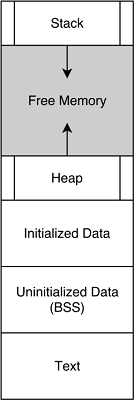
Image From: commons.wikimedia.org - Typical computer program's stack frame layout
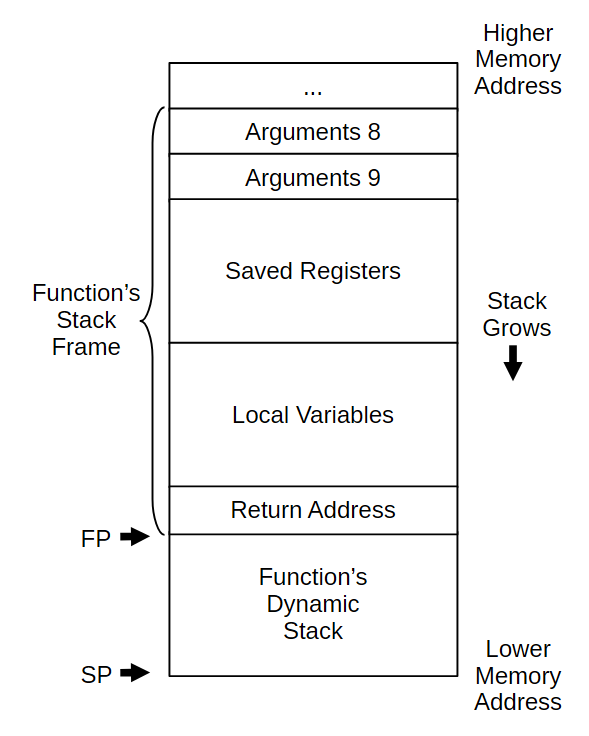
Note:
- RISC-V passes the first 8 arguments to a function using the a0 to a7 registers, not the stack.
- A positive offset from the FP can be used to access data in the stack frame.
- The SP can be uses as the FP if the dynamic stack is not used by the function, or if the SP is reset back to the bottom of the frame.
- RISC-V pseudo-instructions are shorthand commands that the assembler expands into one or more real machine instructions. They make assembly code easier to read and write. For RARS (RISC-V Assembler and Runtime Simulator) instructions, built-in documentation and instruction lists are accessible directly inside the application's Help menu, or online through the RARS GitHub Repository. You can also reference the standard RISC-V Greensheet for complete instruction sets.
- RISC-V Instruction Size
- RISC-V General-Purpose Registers
RISC-V Integer Registers (compact table) - RISC-V Function/Stack
- RISC-V Stack Frame
- RISC-V Function Prologue and Epilogue
- RISC-V J, JAL, JR, JALR
- RISC-V Jump Table
- RISC-V Bit Operations
- RISC-V My Stack Dump
- RISC-V Control and Status Registers
- RISC-V Program Structure
- RISC-V Assembly Language Templates
- RISC-V Floating-Point Numbers
- RISC-V Print Float
- RISC-V IEEE 754 Floating-Point Standard
- RISC-V Decimal Floating-Point
- RISC-V Compare Floating-point Numbers
- RISC-V Arrays and Lists
- RISC-V Heap
- RISC-V Sections
- RISC-V Read Integer From Console
- RISC-V RARS Write To File
-
RISC-V RARS Read a File (one-buffer-at-time)
RISC-V RARS Read a File (one-line-at-a-time) - RISC-V RARS MIDI (sound/music)
- ASCII (oct,dec,hex)
ASCII dec
ASCII hex - Number Converter (bin,oct,dec,hex) (Useful Tool)
Some Projects
| Project #1 | Project #2 | Project #3 | Project #4 |
| Project #5 | Project #6 | Project #7 | Project #8 |
| Project #9 | Project #10 | Project #11 | Project #12 |
| Project #13 | Project #14 |
RISC-V ALE Exercise Book
RISC-V Practice Problems
RISC-V-Assembly-Introductory-Exercises
Some Useful? Definitions
| ABI | Application Binary Interface
RISC-V Defines 1. register aliases 2. calling conventions 3. caller-saved and callee-saved registers 4. stack management 5. data types and sizes 6. system calls 7. is the standard low-level contract that allows independently compiled code, libraries, and the operating system to work together. |
| ALU | arithmetic logic unit | CPU | central processing unit
(it is the "brain" of a computer)
1. fetches instructions from memory 2. decodes commands to determine what action to take 3. runs programs |
| ISA | instruction set architecture
1. an abstract model that defines the programmable interface of the CPU of a computer 2. defines how software interacts with hardware 3. defines what the physical processor instructions mean. |
Simplified CPU Diagram
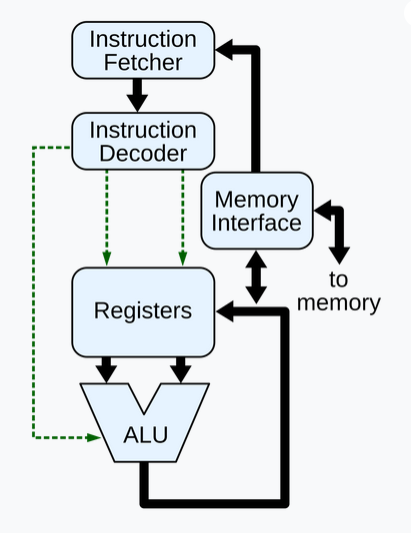
Image From: commons.wikimedia.org
Bonus Question: Who was William 'Wild Bill' Gelbke?